
Loud With The Sound of Hands
We invited award-winning writer Joe Zadeh to visit and respond to our latest gallery exhibition.
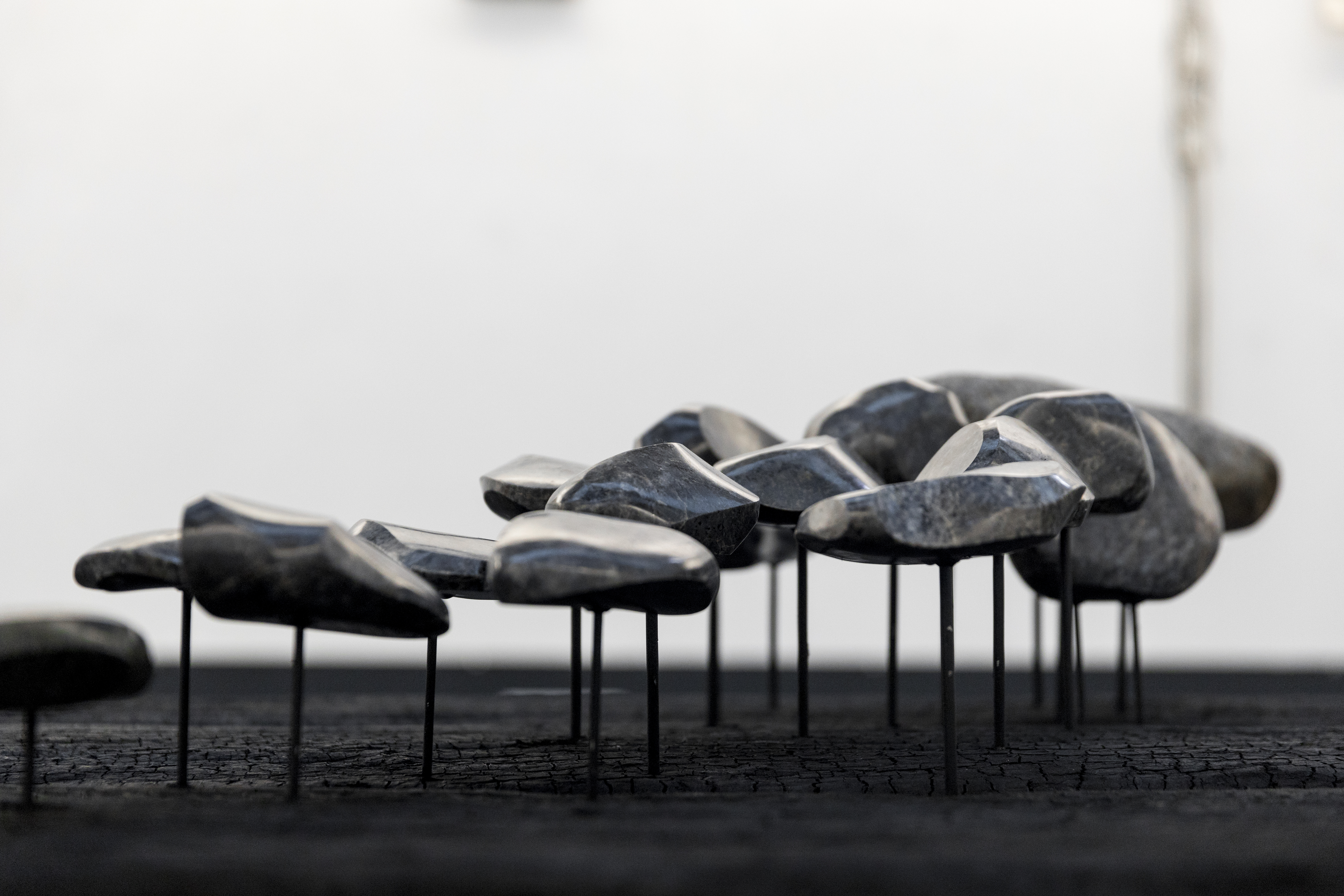
In the rear gallery of Newcastle Arts Centre, I visited the exhibition, ‘Counterweight’ – a group show by Sean Alec Auld, Mani Kambo, Laurie Powell and Bethany Stead that explored ideas of rituals, landscape and myth.

The objects in the room were precious and painstakingly made, all sharing a certain aura. I felt like I was wandering around a collection of cultural and spiritual artefacts from some ancient and forgotten society; artefacts that once held symbolic power, and might still reveal their secret language to me in a sudden ecstatic vision, if I were to stand before them in the right state of mind. And as I moved from piece to piece, I found that I could not stop thinking about hands.

There were literal images that triggered these thoughts: like the two open-palmed hands stitched into Kambo’s black and white canvas, or the wounded hand in Stead’s ceramic stoneware. But even more visceral was the invisible but lingering presence of the artists’ hands themselves. Hands threading needles, tying knots and braiding ropes; hands painting, placing, sanding, moulding, and forging. I imagined Auld’s polishing cold ancient granite and larvikite rocks until they shimmered like orbs, and Powell’s retrieving the tiny moulted feathers of a blue jay from a forest floor. The entire room was loud with the sound of hands.
“I felt strange, strange feelings: as if I was seeing wood and stone for the first time.”
My own hands fizzed with jealousy. I felt an urge to pick things up and feel their weight and texture. I wanted to run my fingertips across the natural curvature of the stones and the ripples of the braids, and gently prick them on the thorns that recurred throughout numerous works. I wanted to place a palm on a mesmerising grain of a square piece of ash mounted on the wall, close my eyes and give it a chance to do something. I felt strange, strange feelings: as if I was seeing wood and stone for the first time.
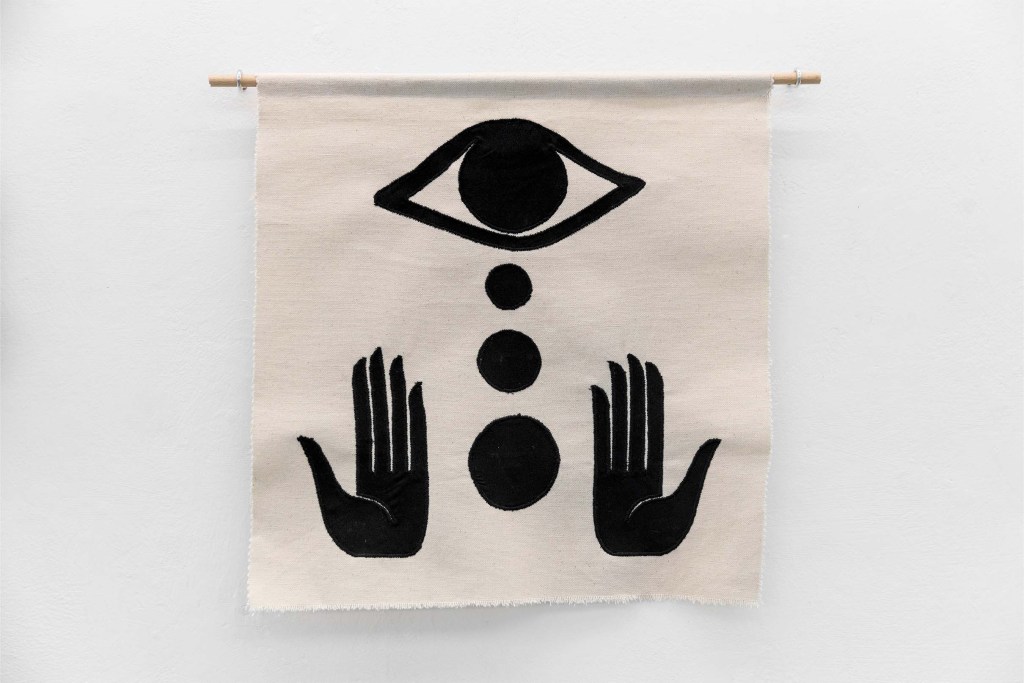
As I stood in front of Kambo’s canvas, I considered my own open palms. I once read a book that described hands as “wondrous grasping organs” and it changed the way I’ve looked at them ever since. Lucid dreaming experts say that looking at your hands is one of the most effective reality checks to establish whether you are awake or dreaming: count the fingers and inspect the palms and look for aberrations from the norm. Our hands can ground us in physical reality. Look at them for too long, however, and they begin to seem unfamiliar and jarring, like the way a word said aloud too many times can dissolve into meaninglessness.

In the last few years, AI-generated image tools have started to create perfectly rendered images of human faces and bodies, almost indistinguishable from photographs, except for the hands. There’s something graceful and animalistic about hands that the machine doesn’t quite get. It becomes terribly confused, depicting them as nightmarish appendages with an excess of fingers or misplaced joints, or, even creepier, no joints at all.
“When did you last admire the beauty of a branch? Have you ever felt kinship with a stone?”
There is a connection between hands, myths and rituals that I’m working towards. Myths and rituals have a chicken and egg relationship. In a general sense, myth is story and ritual is action – but did the story inspire the action or did the action inspire the story? Are myths and rituals separate from each other, or are they utterly inseparable? It’s safe to say that they have to have different forms: myths are mental and abstract, whereas rituals are bodily and physical. Myths gestate in the mind; rituals spring forth from the hands, just like the objects that surrounded me. One of the oldest works of art in the world, Cueva de las Mano (Spanish for Cave of Hands), was created in several waves between 7,300 BC and 700 AD and is most likely ritualistic in origin. It features hundreds of paintings of hands stencilled onto the rocky walls of a cave, but nobody knows exactly why anymore.

After an hour in the exhibition space – as I stared at Stead’s paintings of gannets eating humans, and humans in animal skins – I started to hear some of the deeper questions the exhibition may have been asking me: When did you last admire the beauty of a branch? Have you ever felt kinship with a stone? Have you ever considered yourself inescapably entwined with the fate of all animals, plants and things? When was the last time you saw the world as filled with meaning and mystery?

Those questions kept drawing me back to one particularly vivid memory, a memory of my hands. It was four years ago. I’d moved into a new flat and, for the first time in my adult life, had a garden. For the first few months, the overgrown greenery and the sycamore tree in the corner were just something I gazed at from my bedroom window – usually procrastinating from my laptop – with very little feeling at all. But as the spring months came, something beckoned me.
“Things revealed themselves slowly, like stars.”
I knew nothing about plants, but I felt a deep urge to grow vegetables. I cleared a space in the corner, near the sycamore, and built a raised bed from reclaimed yellow bricks; three feet high and rectangular in shape. I filled it with compost, planted rows of seeds of lettuce, tomato, sweetcorn, radishes and beans, and built a bamboo structure for the beans to climb. It was a ramshackle and crooked monument, but I felt a sense of pride when it was done. I’d say it was the first and last time my hands had built a structure of any sort, other than flatpack furniture.

From the moment my seeds were planted, things started to change. The raised bed had an odd magnetism. I found myself wanting to sit near it as much as possible, as if I could watch things grow in real time. It lured others too. The man from next door saw me there one afternoon and wandered over to introduce himself, and offered the use of his hose for watering, and any other tool I might need. The man from upstairs, who usually smoked his cigarettes out of his bedroom window, started smoking them next to the bed, chatting with me as he did. A little boy with blonde hair who I had no idea even lived in my building came and offered me a bag of horticultural sand.

Things revealed themselves slowly, like stars. I started to notice the crows that frequented the grass, and the grey squirrels that lived in the sycamore, and the way the sycamore bobbed in the wind. I began to recognise the robin that liked to perch on any tool I left outside, and the rat that lived under the abandoned rusted barbecue in the corner and was not afraid of me at all. I noticed the insects that visited the flowers on my radishes. I noticed them all because, just like my neighbours, I felt that I was now in dialogue with them, whether I liked it or not. I felt attuned to my local community at a more than human level, and the more time I spent in the garden, the more I looked at them all with eyes of love. “I believe the earth continues to call you, once you get your hands in it,” wrote the American writer Jean Marie Laskas.

That would have been a sweet ending. But like all interactions, my newfound dialogue with nature made my life richer with one hand and vastly more messy and complicated with the other. Whenever I dug my hands into the ground or lifted an unturned stone, I was filled with murderous revulsion for the terrifying slimy and grimy creatures that lurked beneath. Plants I never planted – like bindweeds, dandelions and nettles – burst through the soil and sucked life from my vegetables. When a lettuce went missing, leaving behind a gaping hole of disrupted soil, I couldn’t help but feel personally attacked. I started looking at every bird and squirrel, each of the neighbour’s cats and dogs, with boiling suspicion, saying silently in my head: ‘Was it you?’ I began doing things that verged on witchcraft, like scattering a perimeter of old coffee grounds to ward off slugs and snails. At every stage I felt faced with that everlasting fundamental question: am I conquering this patch of land or collaborating with it?

Amidst all the joy and pain that bit of soil brought me, I never quite got to the bottom of that question. My tenancy ended and, like all renters, it was time for me to move on and start a new home somewhere else, again. I wonder if my precious bed is still there, in the corner, under the tree – the bricks displaced and partially collapsed, but still vaguely resembling a rectangle, perhaps. I wonder if it’s clear to whoever lives there now that something small but meaningful, something almost ritualistic, happened there, even just for a fleeting moment in time. One day I’ll go back and put my head over the wall and have a look.

I’d forgotten so many of the rich qualities of this memory until my visit to the Counterweight exhibition. I like to think that’s what art does: provokes something hidden, pulls you out of the mundanity of everyday life, and makes you feel suddenly enmeshed in, what the British novelist Evelyn Underhill called, “the sacred plane of life and energy”.
Joe Zadeh is a writer based in Whitley Bay.

'Counterweight' ran in the Newcastle Arts Centre gallery, from 20th January – 24th February 2024.

Featuring Sean Alec Auld, Mani Kambo, Laurie Powell and Bethany Stead

Curated by Jed Buttress

Supported by the Creative Central: NCL programme, funded by the North of Tyne Combined Authority and Newcastle City Council



Leave a Reply